What Even Is a Dopamine Menu?
If you’ve been anywhere near TikTok in the last few months, you’ve probably seen someone enthusiastically categorizing their joy into a restaurant-style menu. The dopamine menu trend started with ADHD coach Jaclyn Paul, who reframed how we think about pleasure by sorting activities into effort levels: appetizers (the low-effort hits), main courses (the medium-engagement activities), and desserts (the big, meaningful ones). It sounds silly until you realize you’ve been desperately scrolling Instagram at 2 a.m. instead of doing literally anything else.
The concept caught fire for a reason. We’re living through a particular kind of exhaustion right now. According to the APA 2025 Stress in America Report, 77% of adults named work as a significant source of stress, the highest number since 2019. When you’re that burned out, your brain stops reaching for the things that actually nourish you. Instead, it reaches for whatever’s fastest and most immediately satisfying, which is usually something on a screen.
The Setup: Why I Actually Decided to Try This
Full transparency: I was skeptical. I’m the person who watches wellness trends zoom past me like I’m standing still. But I was also tired. Not the kind of tired that sleep fixes. The kind where you finish work and genuinely cannot remember the last time you did something that felt good in a non-numb way.
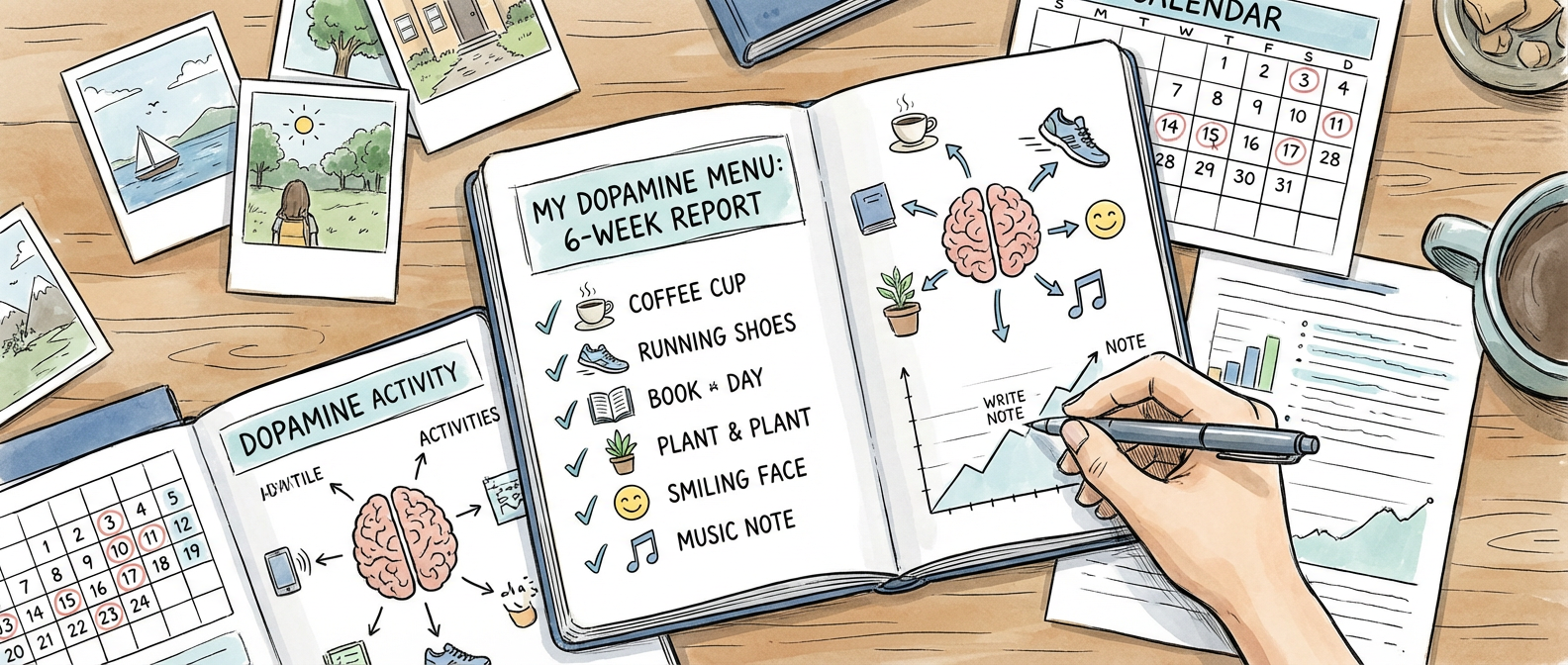
I decided to build my dopamine menu over six weeks. I made an actual Google Doc with the three categories and started small. Appetizers included things like brewing good coffee, watching one episode of something comfort-watch, or taking my dog for a neighborhood loop. Main courses were things like painting, calling a friend I hadn’t talked to in months, or cooking something that required actual attention. Desserts were the bigger ones: a hike I’d been putting off, a weekend trip, trying that new bookstore everyone was talking about.
What surprised me most? Having it written down changed something. When I was spiraling about having wasted my evening, I could glance at the doc and pick something actual instead of just defaulting to my phone for the third time that night.
What Actually Happened Over Six Weeks
Research backs up what I started noticing. A 2025 study in the Journal of Behavioral Medicine found that when people intentionally scheduled positive activities, burnout symptoms dropped by 34% over eight weeks for remote workers. I’m not a remote worker, but I am someone with a job that demands emotional energy. Building in those appetizers and main courses felt like basic maintenance that I’d somehow let slip.
Week two was when I noticed the real shift. I’d grabbed coffee from my favorite place and sat outside for ten minutes instead of taking it back to my desk. I know that sounds unremarkable, but it was the first time in months I’d done something small just because it felt nice, not because it was efficient or productive. The appetizers weren’t meant to be transformative, but stringing a few together throughout the day actually was.
By week four, I’d stopped reaching for my phone quite as automatically. It wasn’t willpower. It was that I actually had other things I wanted to do. I’d painted twice. I’d made plans to see a friend I’ve been meaning to catch up with. The desserts were still weeks away, but knowing they existed made the hard days feel less infinite.
The Part Nobody Mentions: Where This Actually Gets Interesting
Dr. Anna Lembke, psychiatrist and author of “Dopamine Nation,” has noted that structured pleasure can help reset how your brain responds to reward, especially if you’re stuck in the passive-scrolling doom loop. The dopamine menu forces you to be intentional. You’re not just consuming whatever the algorithm serves you. You’re choosing.
That matters more than it sounds. By week five, I genuinely wanted to do these things instead of forcing myself. The menu stopped being a to-do list and became more like a reference point. On days when I felt completely hollowed out, I could look at the appetizers and do one thing that was just for me, no productivity required.
The hashtag #dopaminemenu had racked up over 620 million views on TikTok by early 2026, which makes sense because the trend actually addresses something real: most of us have lost track of what we find genuinely pleasurable. We’re chasing productivity or scrolling numbly, and there’s not much in between.
Who Should Actually Do This, and Who Probably Shouldn’t
I’m recommending this specifically to people who recognize themselves in this description: you finish the day and cannot account for where your energy went. You open your phone planning to do one thing and look up to find an hour has vanished. You know what makes you happy in theory, but you rarely actually do those things. You’re not depressed exactly, but you’re not thriving either. You’re managing.
If that’s you, build a menu. Make it specific. “Watch TV” doesn’t work, but “watch one episode of The Great British Bake Off” does. “Spend time outside” isn’t it, but “take a walk around the pond and sit on the bench by the water” is. The specificity matters because it removes the decision-making when your brain is too tired to decide anything.
If you’re already running on fumes and need actual professional support, a dopamine menu is a supplement, not a replacement. If you’re grieving or clinically depressed, this is a nice tool but not the main thing you need.
After Six Weeks: What Stuck
I’m still using my menu. It’s evolved a bit. Some appetizers got swapped out. One main course became a dessert because I kept doing it and now it feels less special and more like routine, which is fine. I added something else to take its place. The point is, I stopped defaulting to my phone at 9 p.m. I’m reading more. I actually remember the last time I did something I enjoyed, which is a low bar that I somehow wasn’t clearing before.
Did this fix my life? No. Did it give me a framework for intentional living that actually works for my brain? Completely yes. I’m genuinely recommending this if you’re stuck in the kind of burnout where you can’t remember when you last felt actually good. The dopamine menu doesn’t require you to feel motivated. You just pick the thing, do the thing, and let that be enough.
Have you tried building a menu? I’m curious what your appetizers actually are, especially the ones that surprise you once you start paying attention. Drop a comment or send me a thought.
