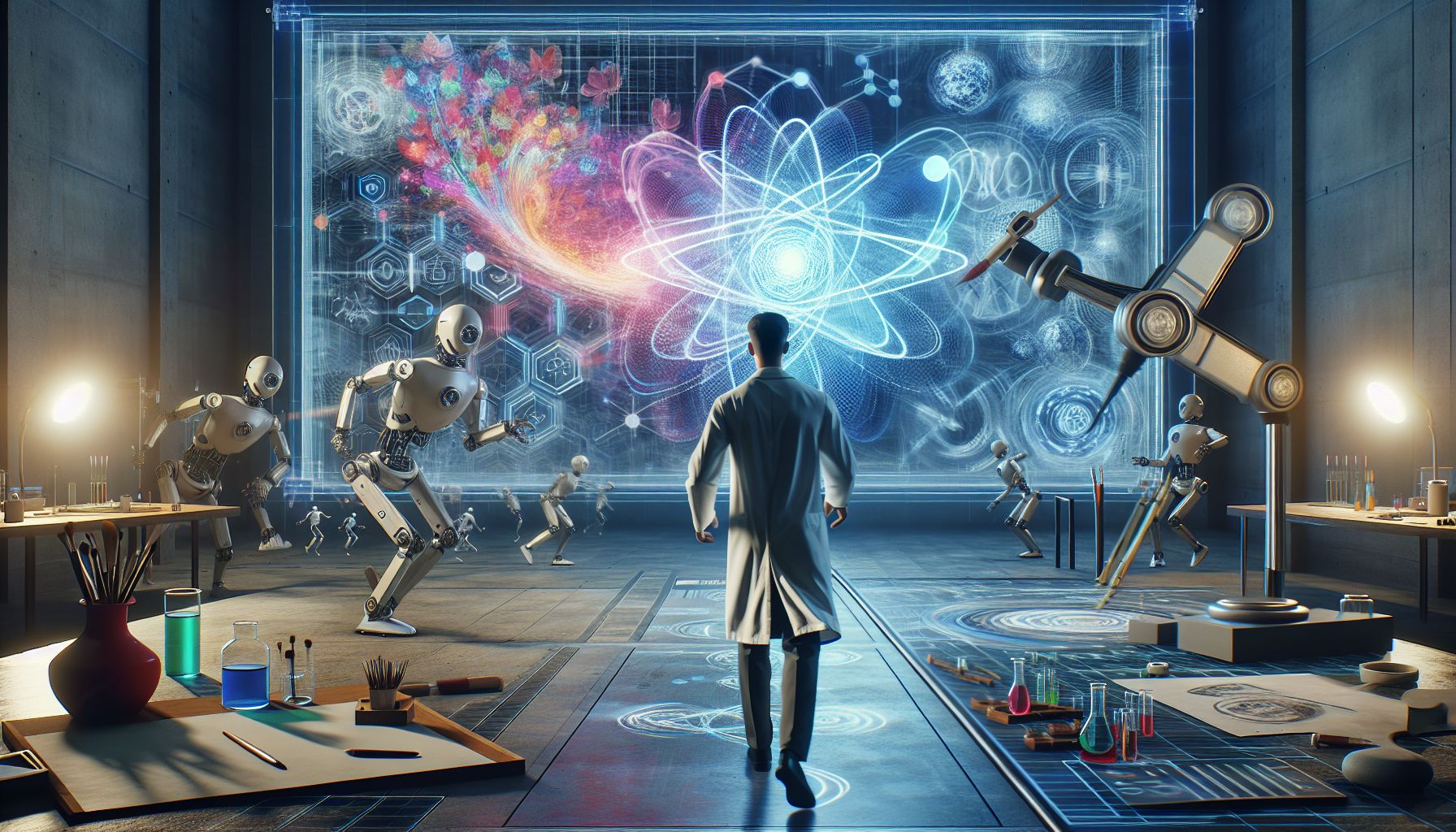
Hey tech enthusiasts! Gather ’round because today we’re diving deep into a fascinating subject that’s been on my mind lately: Artificial Intelligence in the realm of creative arts. Yeah, that’s right! We’re talking about machines getting their paintbrushes, writing novels, composing symphonies, and making movies. It sounds a bit sci-fi, doesn’t it? But trust me, it’s way more reality than fiction these days. So, grab a coffee—or whatever fuels your geeky heart—and let’s jump in!
When Machines Met Creativity
If you’ve been paying even the slightest attention to AI, you’ve probably heard about how they’re being trained to beat us at chess, diagnose diseases, and drive our cars. But what you might not know is that their digital tentacles are also stretching into the highly subjective and traditionally human domain of art and creativity. Pretty wild, huh?
I remember the first time I saw an artwork created by an AI. It was this trippy abstract painting, and for a second, I thought it was one of those modern art pieces you stare at and think, “Is this upside down?” But nope, it was a genuine product of algorithms, so perfectly imperfect.
The Training Ground
The way AI learns creativity is pretty mesmerizing. Imagine feeding an AI model thousands of paintings by Picasso or Monet. It starts by learning patterns, brush strokes, color shades, and composition styles. You know, like how we awkwardly learn ‘stick figures’ before graduating to drawing something remotely recognizable. Except, for AI, this learning phase happens at warp speed.
Neural networks, particularly GANs (Generative Adversarial Networks), are the secret sauce here. They have two networks—one generating content and the other evaluating it. It’s a bit like having a devil and angel on each shoulder but maybe less chaotic!
AI Music: The Digital Symphony
Alright, let’s shift tunes—literally—to music. AI in music composition is another exciting development. Take OpenAI’s MuseNet, for example, which can generate 4-minute musical compositions with influences from country, classical, and jazz, blending them into a single piece. Fancy a symphonic tune mixed with a bit of guitar lick? Believe me, AI’s got your back!
Jamming with Algorithms
I have an amusing story here. A musician friend once introduced me to a piece composed by AI and challenged me to tell it apart from a human composition. Spoiler alert: I failed miserably. The AI had integrated such emotional depth into the symphony that it was hard to distinguish. If AI can compose ballads that make you tear up, or techno beats that make you want to dance like nobody’s watching, well, consider me officially impressed!
Writing: From Algorithm to Author
Now, onto a subject I’m particularly fascinated by: AI as an author. You might think writing is too nuanced for machines, too reliant on the complexities of human experience. But AI like OpenAI’s GPT series has been proving skeptics wrong, generating content that ranges from blog articles to full-fledged short stories. Even more striking is their ability to adapt styles, copying famous writers or experimenting with avant-garde forms.
Plotting Prowess
As someone who pens down tech articles daily, I find enormous potential here. Imagine writer’s block—an infamous enemy to every writer—being dethroned by an AI assistant equipped with an infinite well of creativity. Writers are now using AI to brainstorm ideas, draft outlines, or provide alternative endings. I still write my own blogs, but the potential is so tantalizingly close, I might just hire an AI co-writer one day!
Film-Making: The Automated Auteurs
And then there’s film-making. Gone are the days when human directors exclusively held the reins. Today, AI can analyze huge datasets of scripts, predict audience preferences, and assist in creating mind-boggling effects. In some instances, they’ve even contributed to storyboarding and cutting trailers.
Behind the Screens
Imagine an AI analyzing all the Oscar-winning films and identifying the secret ingredients to box-office success. While the thought of AI-directed movies might make cinema purists squirm, the advantage is undeniable. The day may not be far off when a Sundance Festival hit is made by an AI filmmaker. Just think of it: no trailer spoilers because AI can’t accidentally spill the plot, right?
Challenges and Ethical Dilemmas
With all this excitement comes a slew of challenges and ethical ponderings. What happens to the role of human artists? Does AI-generated art hold the same value as human-made creations? What does copyright look like in a world where an algorithm creates? These questions are as complex as the technology itself.
Keeping Humanity in the Loop
As much as I’m thrilled about AI’s creative potential, I’m equally wary about keeping humanity central to the artistic process. Sure, AI can analyze data and recognize patterns faster than humans, but the beauty of art lies in its imperfections and emotional resonance. As we hurtle toward this techno-creative future, finding a balance will be crucial.
Weird and Wonderful Territory Ahead
It’s an electrifying time to be tech-savvy and alive, folks. AI’s voyage into the arts isn’t just about doing things faster or cheaper; it’s about broadening horizons and challenging the boundaries of what’s possible. We are inching toward a future that marries human ingenuity with artificial ingenuity, where art, music, and writing are redefined by collaborative human-machine partnerships.
So, whether you’re a creator, consumer, or casual admirer of the arts, embrace these innovations. Our creative landscape is undergoing a radical transformation. And while AI paints its abstract masterpieces and hums its digitized sonatas, let’s not forget to enjoy the ride, flaws, eccentricities, and all. Isn’t that what art is truly about?
Until next time, stay curious and keep questioning the world around you. Who knows? The next artistic muse might just be running on silicon.
